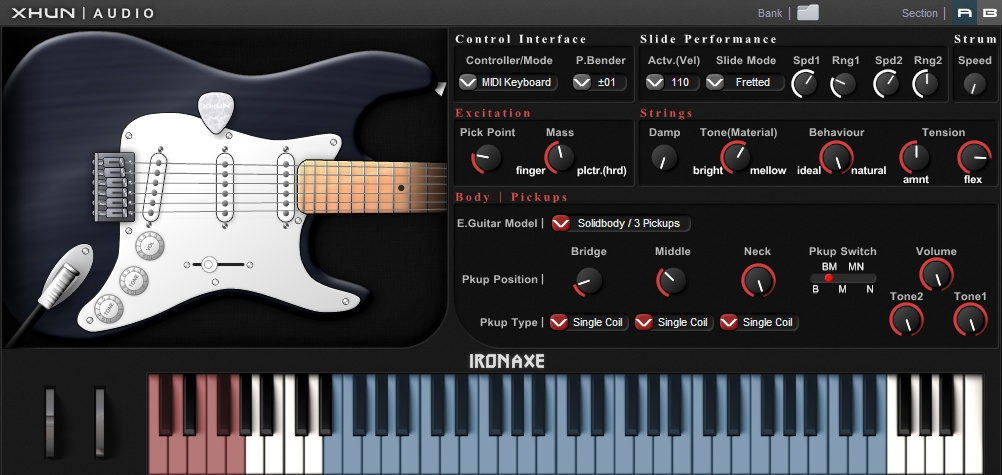
 IronAxe is a high-end Physical Modeling simulation of one of the most popular and loved electro-acoustic instruments of all time :
the Electric Guitar.
IronAxe is a high-end Physical Modeling simulation of one of the most popular and loved electro-acoustic instruments of all time :
the Electric Guitar.
The result of many years of research and development,
IronAxe reaches all the authentic beauty and expressivity of a real Electric Guitar
by simulating the physics of all the acoustic and electronic components found in the
original instrument, preserving the same nuances and multi-techniques playability
impossible to perform on standard frozen-sounding sampled instruments.
Break with the past - forget all the old, expensive, bulky sample libraries.
With IronAxe you can build your custom Stratocaster©¹ or Telecaster©¹ guitar,
choose Pickups type, number and position, set the Tone knobs to get the right sound,
select the Plectrum hardness or pluck a String with fingers at any point along its
length. Finally take real-time control of all this (and much more...) using a MIDI Keyboard
or a real - natively supported - MIDI Guitar.
IronAxe will bring in your next Productions the sound and feel of a real Electric Guitar.
And the included full set of analogue modeled Stompboxes,
legendary Amp/Cabinets and Room Simulation,
make IronAxe a perfect tool for advanced guitar sound designing, without the need of additional (and expensive)
external software/hardware units.
A full electro-acoustic setup, just at your fingertips.
|
 Modeling Nature and Physics is a growing practice for reaching
true-to-life systems simulations with 'alive' feedbacks, including complexity
management and unpredictability integration.
Modeling Nature and Physics is a growing practice for reaching
true-to-life systems simulations with 'alive' feedbacks, including complexity
management and unpredictability integration.
While in the past running an accurate Physical Modeling simulation was possible
(due to its complexity) only on expensive multi-processor workstations or even
computer clusters, today thanks to the exponential increase of modern CPUs' processing
power, reaching parity with real instruments is possible
in real-time (including polyphony and multi-istances possibilities) at a fraction of the costs.
IronAxe is the first in a series of instruments developed by Xhun Audio to use this revolutionary technology.
The core of this kind of approach is the interaction between the Instrument's model, the Performer's model
and the Unpredictability simulation.
All the six Strings, the Transducers (Pickups), the Plectrum/Finger excitation and more as well
as Performer's actions like Palm Muting, Tapping Harmonics (even muting a String after
its excitation is possible) are physically simulated. Add Unpredictability (instrument's and
performances' micro-imperfections) to the equation and what you hear at the end of
the whole process is given by the interaction of this three worlds.
The result is an 'alive' instrument, a state-of-the-art simulation for an unparalleled realism.
|
|
Blcmm Invalid File Selected Instant
Furthermore, the persistence of this error highlights a within the modding community. BLCMM, once the gold standard, has been superseded in many circles by OpenBLCMM , a fork that supports newer mod types and fixes legacy bugs. However, countless archived forum posts and old YouTube guides still point new users to the original, unmaintained BLCMM. Consequently, a user following a 2018 guide may encounter the “Invalid File Selected” error when trying to load a modern mod that uses encoding or compression methods the original BLCMM cannot recognize. The file is not invalid in an absolute sense; it is incompatible with the specific toolchain . The error thus becomes an unintended indictment of the community’s archival practices. It punishes the newcomer for not knowing the secret history of tool deprecation.
In conclusion, the “BLCMM Invalid File Selected” error is far more than a minor annoyance. It is a microcosm of the challenges inherent in user-generated content ecosystems. It exposes the tension between precise software validation and fallible human expectation, the gaps in community documentation, the decay of digital artifacts over time, and the silent obsolescence of once-essential tools. To the frustrated user at 2 AM, it is a roadblock. To the software engineer, it is a successful assertion of data integrity. But to the cultural historian of digital play, it is a footprint—evidence of the living, breathing, and often messy process of players taking ownership of their games, one invalid file at a time. Resolving the error requires not just technical know-how, but a willingness to learn the unwritten rules of a community that, despite its best efforts, still speaks in riddles. blcmm invalid file selected
Beyond syntax, the error often signals a . The Borderlands modding scene, while passionate, is decentralized. Tutorials on YouTube or Nexus Mods forums frequently omit the critical step that mod files must be imported, not simply opened via “File > Open.” Many novice modders, fresh from downloading a .blcm file, double-click it or use the operating system’s “Open with…” command, only to be greeted by the invalid file error. The problem here is not the file, but the user’s mental model of how the manager interacts with the filesystem. BLCMM requires files to be added to a load order via an import dialogue, not launched directly. The error message, in its brevity, fails to correct this misunderstanding. It identifies the symptom—invalid selection—but offers no cure, no redirect to the proper import workflow. This transforms a solvable user-education issue into a frustrating dead end. Furthermore, the persistence of this error highlights a
In the sprawling, user-driven ecosystems of modern video game modification, few experiences are as simultaneously mundane and maddening as the error message. It is the digital gatekeeper, the binary arbiter of permission that halts creativity in its tracks. For users of the Borderlands Community Mod Manager (BLCMM) —a vital tool for overhauling Borderlands 2 , The Pre-Sequel , and Borderlands 3 —one specific error stands as a rite of passage and a source of persistent friction: “BLCMM Invalid File Selected.” Far from a mere software glitch, this error is a multifaceted phenomenon. It is a technical constraint, a pedagogical failure, a symptom of community fragmentation, and ultimately, a reflection of the inherent tensions between structured software logic and the chaotic, inventive spirit of modding. Consequently, a user following a 2018 guide may
|
|